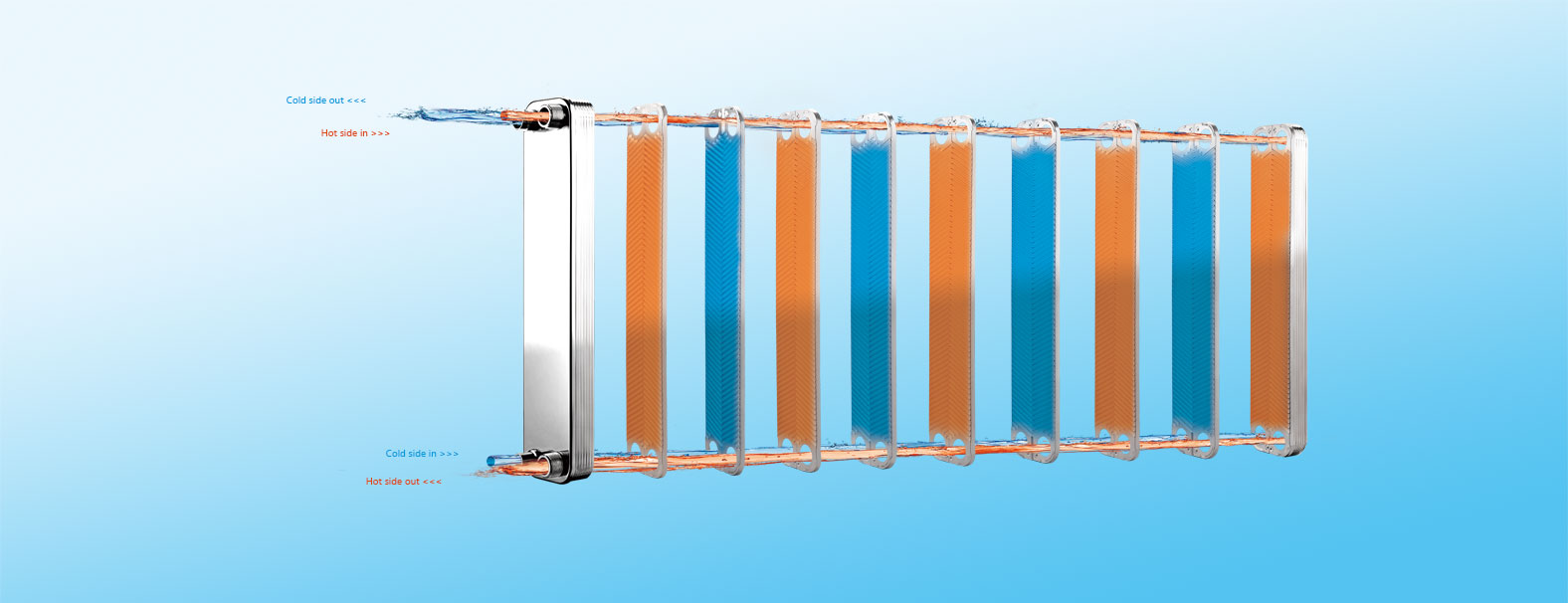
• Working principles of brazed plate heat exchanger
The brazed plate heat exchanger is composed of a number of stainless steel plates, which have a pressed pattern of arrow ridges. As shown in the figure above, the stainless steel plates are of identical shape, while a following plate has been turned 180° relative to the antecedent one. Since the plates are stacked to contact each other, channels and contact points are formed between them. After stacking, the plates are joined at the contact points by the brazing material in the high vacuum brazing furnace.
The working mode of the fluid in the plate heat exchanger is based on an alternating arrangement for cold and hot fluid channels : one channel is for cold fluid, the next channel for hot fluid, and then for cold fluid again. The cold and hot fluids are staggered to fully exchange the heat. In this way, the efficiency can be maximized.
• Applicable system equipment:
Evaporator, condenser, cooler, economizer, intercooler, economizer, heat recovery device, water/oil cooler, etc.
• Applicable fluids:
Various refrigerants, water, oil, steam, glycol solution, alcohol, coating, weak acid, weak alkali solution, etc.
• Applicable fields:
Heat pump, water cooler, oil cooler, injection molding machine, air conditioner, freezer, air dryer, water cooling, constant temperature cold storage, low temperature laboratory, waste heat recovery, wall-hung boiler, floor heating, central heating, water heating, oil pressure-type machinery, wind power generation, automobile hydraulic system, hot water system, heating system, cleaning system, etc.
• Unique design with unequal cross-sections channels
According to the needs, we use high-efficiency heat exchanging plates with unequal cross-sections channels to accurately match users' different requirements for pressure drop and heat transfer of hot and cold fluids, reduce the heat exchange area of the heat exchanger, and optimize the user's allowable pressure drop and heat exchange capacity to save users' installation space, equipment investment and operating costs.